
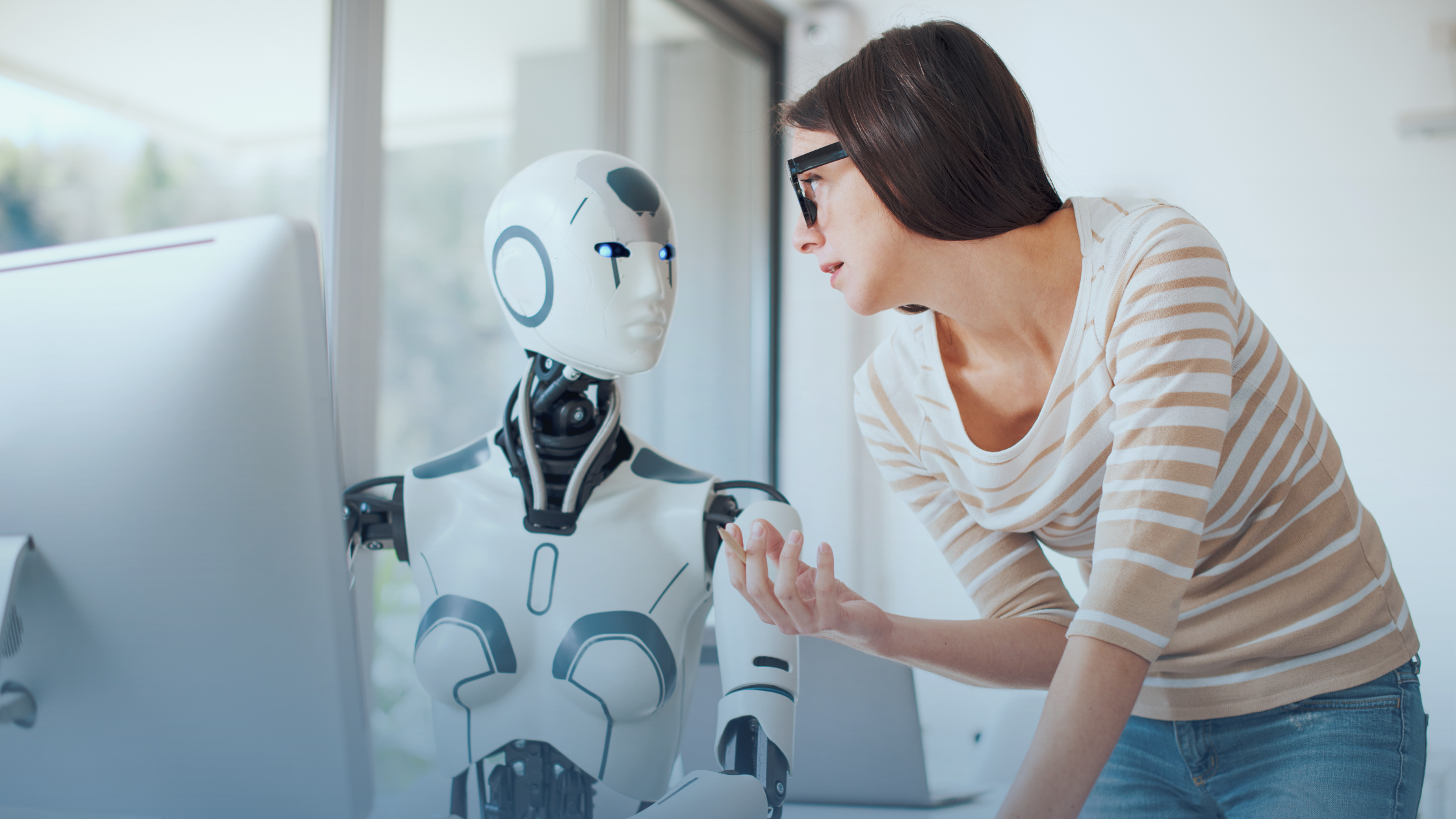

Last month, after a major backlash, a school district in western New York announced that it was postponing plans to use a robot in its classrooms. The Salamanca City Central School District had planned to deploy a humanoid robot named Sally to interact with high school students in STEM and arts courses. The robot would be supplied through a partnership with Realbotix, a former cryptocurrency company that has now pivoted to robotics and owns a sex doll company.
Around the same time that Sally was announced, Anthropic, the popular creator of the Claude chatbot, also made a big announcement. It released Claude for Teachers, a new generative AI product designed for educators. Instructors can use the platform for tasks like creating and differentiating lesson plans. Anthropic encouraged teachers to sign up for one free year by uploading their school ID or contract, and to use its agentic AI tools to analyze class data.
The distinct reactions to these two products deserve closer examination. While “Sally” was greeted with a strong negative response that led to a swift walkback, Claude for Teachers might deserve the bigger backlash. Don’t get me wrong; I was as horrified as anyone by the Sally robot, with its Instagram face and an expression that can only be described as dazed. It does not belong in a classroom. But once you take away the shock value and look at how these two products stack up against legal requirements for products in schools, Claude for Teachers might be an even worse offender.
1. Uploading Sensitive Data to a Third-Party Platform Raises Legal Concerns
When you hear about Sally, your first question might be, how could this happen? What district in its right mind orders a robot teacher from a sexbot company? I watched the city’s Board of Education meeting where the project was discussed. Turns out officials based the decision on the same earnest themes most commonly raised when any AI project is introduced in any school: access to “cutting-edge technology” and a fear of being left behind.
In fact, officials described Sally as a better and more secure alternative to chatbots like ChatGPT and Claude, because the robot is part of a “closed-loop system” in which the product does not access the Internet and no data is sent back to Realbotix. In a presentation, the superintendent said that if the robot was programmed the same way in the form of a golden retriever instead of a woman, he doubts there would have been such a negative reaction.
Claude for Teachers, meanwhile, raises serious privacy issues related to the transmission and storage of both teacher and student data. In its announcement, Anthropic claimed its product is compliant with FERPA, the federal law that protects student education records. But FERPA only applies to school districts, not companies. Third-party technology companies can’t claim compliance, according to the Public Interest Privacy Center.
To sign up, Anthropic encouraged teachers to upload documents with sensitive information, such as IDs and contracts. Worse, it prompted them to upload student data, including rosters and attendance. Even some technology experts who generally support the use of AI raised concerns. Mark Racine, an educational technology consultant and “a big fan of Claude,” told the publication Government Technology that “throwing around terms like ‘FERPA-compliant’ just feels like a little bit more marketing.”
Takeaway: Any third-party product that collects sensitive teacher and student data poses risks, and a technology company can’t claim on its own to be FERPA-compliant. Educators and staff should never upload sensitive information to third-party tools without district guidance.
2. Free Now Means Expensive Later
Salamanca’s $57,000 Sally robot rightfully drew scrutiny. That money could have been used toward hiring a trained teacher instead, or for evidence-based programs.
For its part, Claude for Teachers brings a different pricing structure with a clear red flag. The program is free for one year and the price is unknown after that. “First one’s free” is a cliché long associated with the stereotype of a drug dealer, but in reality, we are all familiar with how it works in technology. Social media, rideshares, and online marketplaces were introduced to us as free or affordable products. Once companies achieved monopoly or near-monopoly control, eliminated competition, and created dependency in users, they changed the terms to exploit users who had no alternative. This playbook is clear enough to be recognizable at the first stage, and the Claude for Teachers announcement fits.
Takeaway: Districts should expect that free or inexpensive products will become expensive once dependency is created, either through rising monetary costs or extraction of value from districts and its students.
3. Be Careful of Companies Seeking to Bypass Vetting Processes
The Salamanca City Central School District’s decision to put a humanoid robot in a classroom was a terrible decision, full stop. As the teachers’ union NYSUT put it, “our students are not lab rats.” But it was a collaborative district decision. According to the superintendent, the decision was made in consultation with student government as well as local and state authorities.
Anthropic, on the other hand, bypassed the districts by advertising the product straight to teachers. Often, school districts tend to lack adequate tools and processes to properly vet third-party technology before staff and student use. But even to the extent that such guardrails are in place, Anthropic skipped over them by encouraging teachers to upload sensitive data about themselves, their schools, and their students in order to use Claude for Teachers. I know at least one district that had to scramble, interrupting summer plans to send emergency emails asking teachers not to sign up for the product.
There was enough backlash on this point to pressure Anthropic to issue a clarification. Thanks to Mark Racine and other professionals raising concerns, Anthropic updated its Claude for Teachers page to make clear that “whether and how educational data may be used in its product is governed by district and state policies” – not Anthropic.
Takeaway: No matter how much you may trust a brand, don’t let advertising convince you to skip independent legal review and existing security protocols. Companies should not be considered the sole authority on the compliance of their products.
Conclusion
Districts and teachers are being rapidly approached by technology companies looking to incorporate their latest products into schools. The Salamanca City Central School District made an unusual decision, but its motivations were common; officials were driven by a fear of their students being left behind. As companies seek to exploit this FOMO, the stakes are high.
Rather than being left to act on impulse, school officials need high standards and systematic reviews that consider learning outcomes, student privacy, and equity. And resulting guidelines need to be clearly communicated to teachers. Our students aren’t lab rats, but even lab rats have protocols governing their treatment.
At Rudick Law Group, we advise school districts on your technology policies to accomplish your community’s goals and stay compliant with local, state, and federal laws. If you have a policy you’d like reviewed or updated, or if you are curious about creating a new policy, contact us to speak with an attorney.
This article is provided for informational purposes only and does not constitute legal advice. Application of federal laws to specific facts and circumstances requires individualized legal analysis.


.webp)
